
Wave 3D Mode:
Kinetic 3D Wave Grid Simulator
Create mesmerizing spatial 3D animations. Control wave formations, geometric grid layouts, harmonic frequencies, and dynamic studio lighting.
What Wave 3D Mode Actually Does
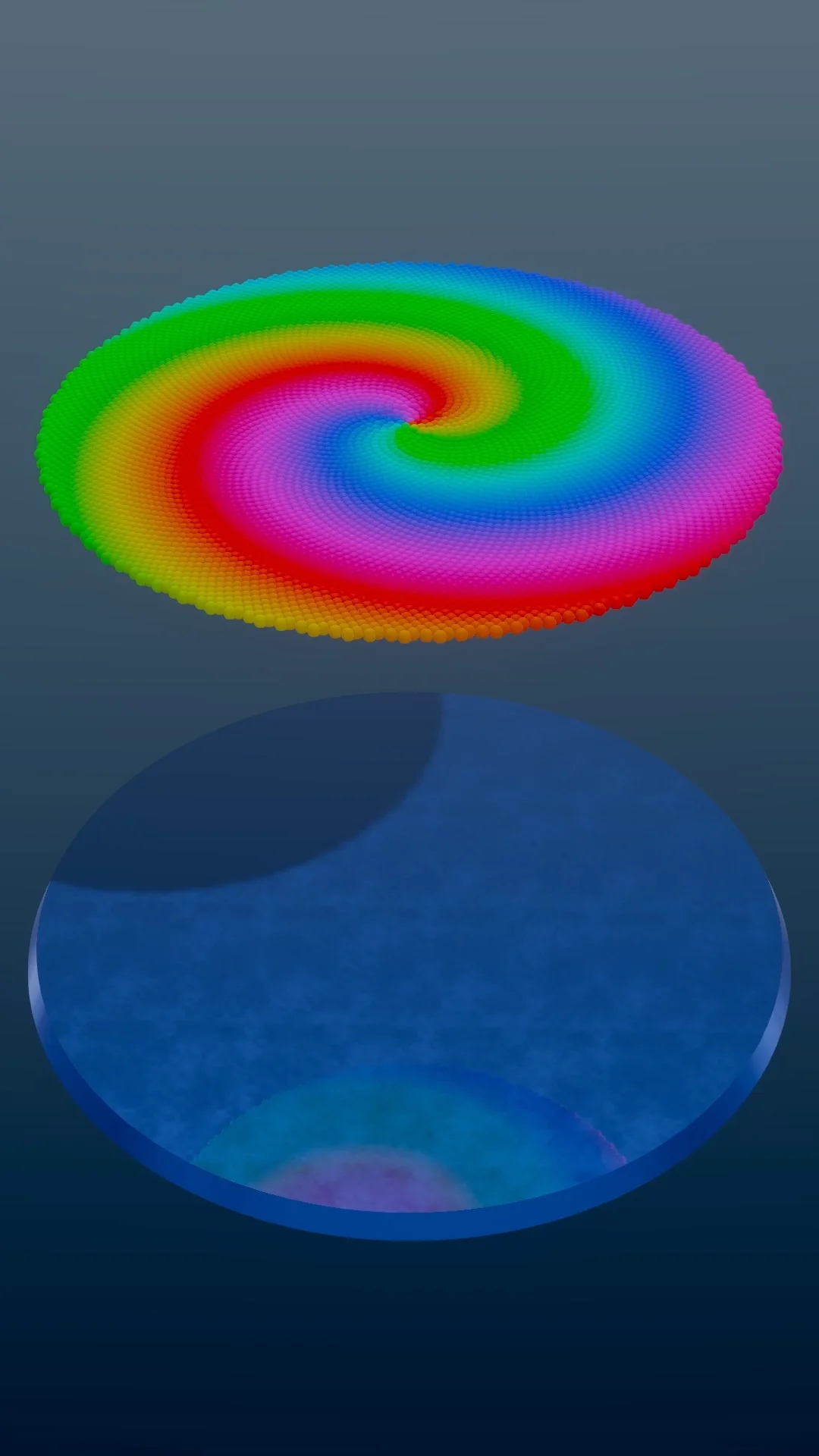
A 3D geometric grid rippling in kinetic waves. Control wave formations, layouts, harmonics, foley impact audio, and spatial lighting.
Wave 3D Mode brings physics simulations into three dimensions. Instead of a flat 2D boundary, hundreds of 3D spheres or cylinders sit in geometric grid layouts that rise, drop, swirl, and ripple in mesmerizing wave formations.
Every wave motion can be driven procedurally by mathematical harmonics or synchronized directly with musical beats and MIDI note melodies. When elements hit the ground platform, they trigger physical material foley sounds — steel-on-steel impact notes that make the kinetic motion feel tangible.
Because Wave 3D runs on Three.js WebGL with GPU acceleration, you get true 3D spatial camera rotations, dynamic depth-of-field, studio shadow casting, and vibrant color gradients across the entire wave surface.
Mode Reference
- Studio mode
- Wave 3D
- Core engine
- Three.js 3D WebGL with Stage3D pipeline
- Formations
- Kinetic bounce, drop, ripple, swirl, and wave harmonics
- Grid layouts
- Hexagonal, Square, Phyllotaxis, Concentric, Flower of Life
- Audio sync
- Material foley impacts & Tone.js melody synthesis
- Best canvas
- Vertical 9:16 portrait for Shorts, Reels, and TikTok
How A Run Plays Out
The exact sequence the engine runs in this mode, from the first frame to the moment the run resolves.
3D grid elements form the layout
You choose the arrangement of the elements: Hexagonal Grid, Square Grid, Phyllotaxis Spiral, Concentric Rings, or Flower of Life. Grid spacing and count set the spatial density.
Formations drive the kinetic wave motion
The active Formation (Bounce Drop, Rise, Ripple, Swirl, Spiral, or Wave Cascade) determines how wave energy propagates across the 3D grid over time.
Harmonics and music sync the movement
Wave Sync styles (March, Beat Sync, Orbit, Spiral Harmony) lock the oscillation frequencies to your song tempo and scale notes, creating hypnotic rhythmic motion.
Ground platform impacts trigger audio foley
As elements strike the 3D floor plate, Material Audio generates authentic acoustic impacts and chime notes that turn the wave ripple into an audible physical performance.
Every Control In Wave 3D Mode
These are the settings this mode adds on top of the shared physics, visual, audio, and export controls. Names match the studio sidebar exactly.
Formations and propagation
These define the kinematic motion curve. Bounce formations simulate gravity drops, while wave sweeps produce continuous undulating ribbons.
Grid geometry and layout
Layout defines the top-down arrangement of elements, from rigid square arrays to organic golden-ratio phyllotaxis spirals.
Audio and impact foley
Material audio gives every physical drop an authentic acoustic impact, while melody sync maps notes across the grid.
Color and visual materials
Color modes shade the grid based on live elevation, distance from center, or rainbow time phasing.
3D camera and lighting
Controls the 3D viewpoint and depth rendering for cinematic short-form vertical videos.
Wave 3D Mode Example Runs
Every clip below was rendered in this mode. Nothing here is borrowed from another mode.
Viral 9:16 Bouncing Ball Run - Music-Synced Loop
Watch this music-synced musical bouncing ball simulation. Renders vertical portrait 9:16 videos optimized for TikTok and YouTube Shorts.
Why Wave 3D Mode Videos Travel
Retention reasons specific to this mechanic, not general advice about short-form video.
Hypnotic 3D motion holds attention immediately
Fluid kinetic wave motion in 3D is immediately fascinating. Viewers stop scrolling in the first two seconds to understand the intricate mechanical rhythm.
Harmonic synchronization creates satisfaction
When undulating 3D waves strike the base in sync with a melody or beat, visual and auditory senses reinforce each other, driving high video completion rates.
Infinite seamless looping potential
Procedural mathematical formations repeat cleanly on exact cycle periods, making it effortless to export flawless infinite loops for YouTube Shorts, Reels, and TikTok.
Premium spatial aesthetic
True 3D lighting, glass shaders, and soft contact shadows give videos a high-production look that distinguishes them from flat 2D animations.
Videos You Can Make In This Mode
Each of these is a different configuration of the same mode, so one setup session produces a batch of related uploads.
Phyllotaxis golden-ratio swirl
A spiraling sunflower seed grid with height-based rainbow gradient and soft ambient foley. The gold standard for calming ASMR visualizers.
Concentric gravity drop cascade
Rings of cylinders that drop from the outer edge inward, striking the plate in ascending musical notes before rebounding.
Beat-synced hexagon pulse
A dense hexagonal grid that ripples outward on every drum kick, with high-contrast neon highlights against a dark floor.
Top-down hypnotic mandala
Camera locked directly above a Flower of Life grid, watching harmonic interference patterns form kinetic optical illusions.
Cinematic orbit showcase
A slow rotating 3D camera moving around a rippling wave field with soft studio shadows and deep color gradients.
Build Your First Wave 3D Mode Video
The order that works. Following it out of sequence usually means retuning settings you already set.
- 1
Select Wave 3D Mode in the Studio
Switch to Wave 3D mode in the Creator Studio to initialize the Three.js WebGL canvas.
- 2
Pick a layout and formation
Choose a geometric layout (e.g. Phyllotaxis or Hexagonal) and a signature formation like Bounce or Radial Wave.
- 3
Attach melody or sound effect
Enable Material Audio and select a scale or sound preset so that impacts produce clean acoustic notes on contact.
- 4
Adjust colors and 3D camera angle
Select Radial Ramp or Height Gradient, dial in high-contrast tones, and set the camera angle for vertical 9:16 portrait framing.
- 5
Export 60fps 9:16 video reel
Review the loop cycle duration, export at 1080x1920 60fps, and publish directly to Shorts, TikTok, and Instagram.
Settings That Make The Difference
- Use Height Gradient coloring to make wave peaks pop with brighter highlights than the troughs.
- Keep one full wave cycle between 5 and 15 seconds for optimal short-form video retention and seamless looping.
- Material Audio is calibrated for realism — pairing soft steel chimes with slow ripple speeds creates instant ASMR engagement.
- Phyllotaxis layout with Radial Ramp gives the most mesmerizing organic patterns in vertical portrait format.
- Enable Ground Reflection and contact shadows to give the 3D platform physical weight.
What Breaks A Run
- Setting propagation speed too high, which turns clean kinetic waves into chaotic visual noise.
- Using low contrast ball and floor colors on a bright background, reducing spatial depth.
- Over-tightening the camera field of view so the outer wave ripples get cut off at phone borders.
- Disabling material foley sounds when building music-synced rhythm runs.
The mathematics of kinetic 3D waves
Wave 3D Mode uses procedural harmonic equations to compute height displacement for every element in the grid simultaneously. By sampling distance from a central focal point and applying trigonometric wave formulas with controllable phase shifts, the simulation creates continuous, non-repeating or cleanly periodic kinetic waves.
Different layout geometries transform how those waves propagate. A regular Cartesian grid produces rectangular diffraction patterns, while a Phyllotaxis arrangement (based on the golden ratio spiral) disperses wave energy in spiraling arms reminiscent of natural biological forms.
Spatial lighting and 3D rendering performance
Rendering hundreds of dynamic 3D elements at 60fps requires an optimized GPU pipeline. Wave 3D batches geometry rendering through custom instance buffers on the GPU, allowing each element to calculate its transform and material elevation in real time without CPU bottlenecks.
The lighting environment utilizes multi-source key and rim lights, combined with soft contact shadows on the ground plate. This gives the elements tangible presence in physical space and ensures that vertical 9:16 video exports look crisp and high-budget on mobile screens.
Wave 3D Mode Questions
Wave 3D Mode is a spatial physics simulation mode built on Three.js WebGL. Hundreds of 3D spheres or cylinders sit in geometric grid layouts (such as Hexagonal, Square, Phyllotaxis Spiral, or Concentric Rings) and oscillate procedurally in kinetic wave patterns. You can customize propagation speeds, wave heights, and harmonic sync styles to create hypnotic 3D visualizers.
In the Creator Studio sidebar under Wave 3D Settings, browse through signature Formations (like Bounce Drop, Ripple, Swirl, Spiral, or Wave Cascade) and Layouts. You can customize the color modes—choosing Radial Ramps, elevation-based Height Gradients, Rainbow cycles, or solid metallic finishes—as well as 3D studio camera angles and contact shadows.
Wave 3D features authentic acoustic Material Audio. When grid elements strike the 3D ground platform, the engine triggers crisp physical impact foley or melodic chime notes. By locking Wave Sync to your chosen song tempo or MIDI scale, the 3D wave ripples land directly on the beat, turning kinetic physics into an audible performance.
Modes That Pair With Wave 3D Mode
Open Wave 3D Mode
Every control on this page is already in the studio. Load the mode and start from a working run.